Why Your AC Can’t Keep Up in the Afternoon
AC runs nonstop but your home still warms up in the afternoon? Learn how thermostat settings, insulation, and other home factors affect cooling performance.
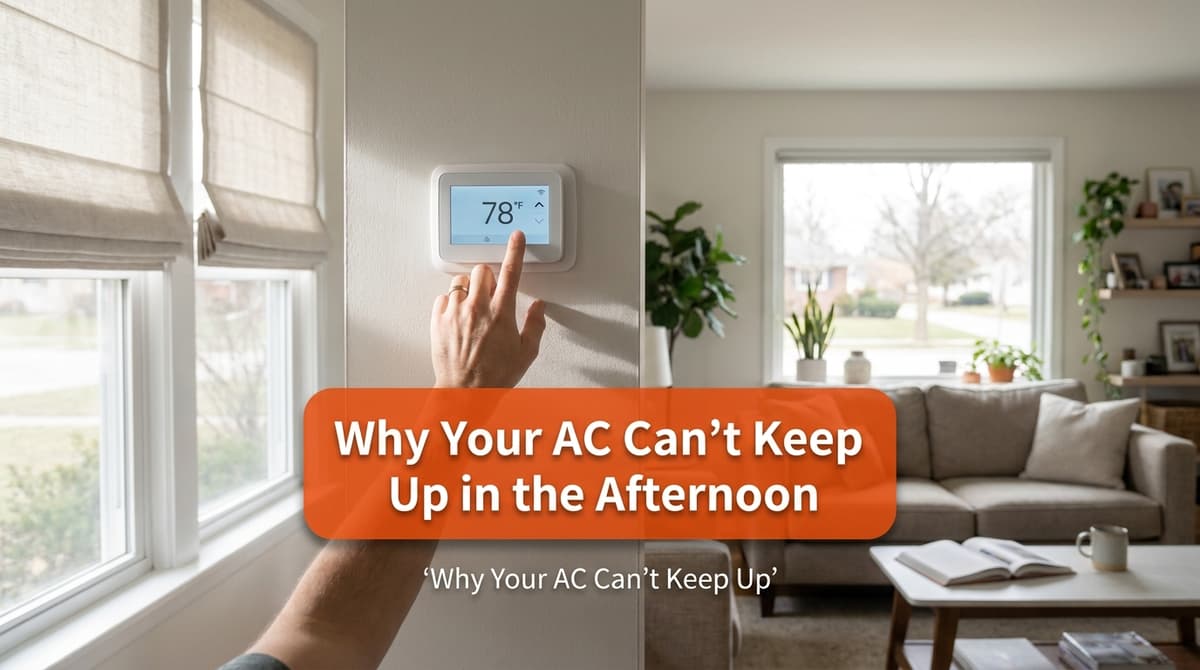
An Afternoon AC Struggle Call
We recently got a call from a homeowner — let’s call him Jason — who was frustrated with his air conditioner. Every afternoon like clockwork, his home would start to warm up. The thermostat was set to 72, but by lunchtime it might read 72–73, and by late afternoon it could creep up to 75 or 76 while the system ran nonstop.
Then, as soon as the sun went down, the house would slowly cool back to the set temperature, and the AC would finally catch a break. Jason had already replaced his thermostat with a basic non-Wi-Fi model and had another company look at the system. Everything “seemed fine,” but his AC still couldn’t keep up during the hottest part of the day.
Jason had two big questions for us: “Do I have my thermostat set up right?” and “Could my older roof or insulation be part of the problem?” Those are smart questions — and they’re ones we hear a lot this time of year.
When Your AC Runs Constantly but Still Falls Behind
Jason’s situation is extremely common. The AC works well in the morning and at night, but between late morning and early evening it struggles to hold the set temperature. Instead of 72, the home drifts up to 75–76, even though the unit never seems to shut off.
In many cases, this doesn’t mean your system is “broken.” It often means it’s hitting its design limits under extreme afternoon heat and sun. Most systems are sized to handle a typical summer day — not the most brutal combination of high temperatures, humidity, and direct sun beating on your roof and walls.
So our job is to figure out: is this normal strain on the system, or is something else (like thermostat setup, ductwork, or insulation) making the problem worse?
Thermostat Settings That Can Hurt AC Performance
Jason had just installed a basic digital thermostat, and he was worried he might have chosen the wrong settings in the installer menu. That’s a valid concern. If the thermostat is configured incorrectly, the system may short-cycle, run inefficiently, or struggle to reach setpoint.
Here are some thermostat-related factors that can affect cooling performance:
- System type setting: The thermostat must be programmed for the correct equipment type (conventional split system vs. heat pump, number of stages, gas or electric heat, etc.). A wrong selection can cause improper run times and staging.
- Cycle rate / differential: Some thermostats let you choose how many cycles per hour or the temperature difference before the system turns on. If this is set too tight, the unit may short-cycle. If it’s set too wide, the home can swing several degrees.
- Fan mode: “On” vs. “Auto” can make a difference. Leaving the fan in “On” can help mix air, but in humid climates it can also re-evaporate moisture off the coil and make the house feel sticky.
- Location of the thermostat: If it’s in direct sun, near a hot kitchen, or under a supply vent, it may not be reading the true average temperature of the home.
With Jason, we asked for a picture of the thermostat and its manual so we could verify that the installer settings matched his system. If we come out in person, we’ll also check the actual room temperature against what the thermostat is reporting.
How Your Roof, Attic, and Insulation Heat Up Your Home
Jason also wondered if his older roof might be to blame. While the shingles themselves aren’t usually the direct cause, the roof system and attic absolutely affect how hard your AC has to work.
On a sunny summer afternoon, your roof can easily reach 140–160°F. That heat radiates into your attic. If the attic isn’t well insulated or ventilated, it becomes a giant oven sitting right on top of your living space. The hotter that attic gets, the more heat pushes down through the ceiling into your home.
Key home factors that impact afternoon cooling:
- Attic insulation level and condition: Old, compressed, or thin insulation can let a lot of heat soak through your ceiling. In many homes we visit, the attic simply doesn’t have enough insulation for today’s energy standards.
- Attic ventilation: Poor ventilation can trap superheated air in the attic instead of letting it escape through ridge vents, soffit vents, or fans.
- Roof color and material: Darker roofs absorb more solar heat. Reflective shingles or coatings can reduce attic temperatures, especially in hot climates.
- Air leaks: Gaps around attic hatches, recessed lights, and ceiling penetrations can allow hot attic air to leak directly into the home.
If your AC can hold temperature at night but falls behind in the afternoon, that’s a strong clue that heat gain from above and from the sun is a major part of the problem.
Other Home Factors That Make Your AC Work Harder
Beyond the roof and thermostat, several other pieces can affect how well your air conditioner keeps up:
- Windows and sun exposure: Large west- or south-facing windows can pour heat into your home. Even good AC can’t fully overcome open blinds on a blazing afternoon.
- Ductwork: Leaky or poorly insulated ducts — especially if they run through a hot attic or crawlspace — can lose a lot of your cooled air before it ever reaches the rooms.
- System sizing: An undersized unit may simply not have the capacity to overcome the heat load during peak hours. On the flip side, an oversized system can short-cycle and struggle with humidity control.
- Maintenance: Dirty filters, clogged coils, and low refrigerant levels all reduce cooling capacity and efficiency.
When we evaluate a home like Jason’s, we look at the whole picture — equipment, ductwork, attic, and even how the family uses the home during the day.
Practical Tips If Your AC Can’t Keep Up
If your situation sounds like Jason’s, here are some steps you can take before and while you call in a pro:
- Check and replace your air filter if it’s dirty or more than 1–2 months old.
- Confirm thermostat settings: make sure the system type matches your equipment, and set the fan to “Auto” unless we’ve advised otherwise.
- Set a realistic temperature: during extreme heat, targeting 72°F might be unrealistic for some homes; 74–76°F with good humidity control can still feel comfortable.
- Use blinds and curtains on sun-facing windows in the afternoon.
- Seal obvious attic leaks around the attic hatch and recessed lights, and consider adding insulation if it looks thin or uneven.
From there, we can measure your system’s performance, check refrigerant levels, inspect the attic and ductwork, and help you decide whether improvements to insulation, ventilation, or even the AC itself will give you the comfort you’re looking for.
If your AC is running constantly and still can’t keep up in the afternoon, it’s not just annoying — it’s a sign that something in the system or the home isn’t working in your favor. We’re always happy to walk through your questions, just like we did with Jason, and help you get your home comfortable again.