AC Not Blowing Cold Air After a Refrigerant Recharge
AC still not blowing cold after a refrigerant recharge? Learn why topping off Freon doesn’t always fix cooling issues and what to safely check before calling a pro.
AC Still Not Blowing Cold After a Refrigerant Recharge
We recently got a call from a homeowner — let’s call him Mark — who was pretty frustrated. A tech had been out to his home the day before because his AC wasn’t blowing much cold air. The technician added refrigerant (what most people still call Freon), but by the next day, Mark and his wife couldn’t feel any real improvement. The air was still lukewarm, and the house was uncomfortable.
Mark’s big question was simple: “If we just added refrigerant, why isn’t my AC cooling any better?” We hear some version of this every summer, and it’s a great question.
Adding refrigerant can help in certain situations, but it’s not a magic fix. If an AC isn’t blowing cold air even after a recharge, it usually means there’s another underlying problem that needs to be found and fixed.
Why Adding Refrigerant Doesn’t Always Fix Cooling Problems
First, it helps to understand what refrigerant actually does. Refrigerant is the “transport vehicle” that moves heat from inside your home to the outside. Your system doesn’t use up refrigerant like a car uses gas — it’s supposed to be in a closed loop.
If a system is low on refrigerant, it’s almost always because of a leak. So when we just add more, we’re often treating the symptom, not the cause. And if something else is wrong — like airflow issues or failing components — the system can still struggle even with the right refrigerant level.
Here are some of the most common reasons an AC won’t blow cold air after a recharge.
Common Causes When a Recharge Doesn’t Help
1. Dirty Coils Blocking Heat Transfer
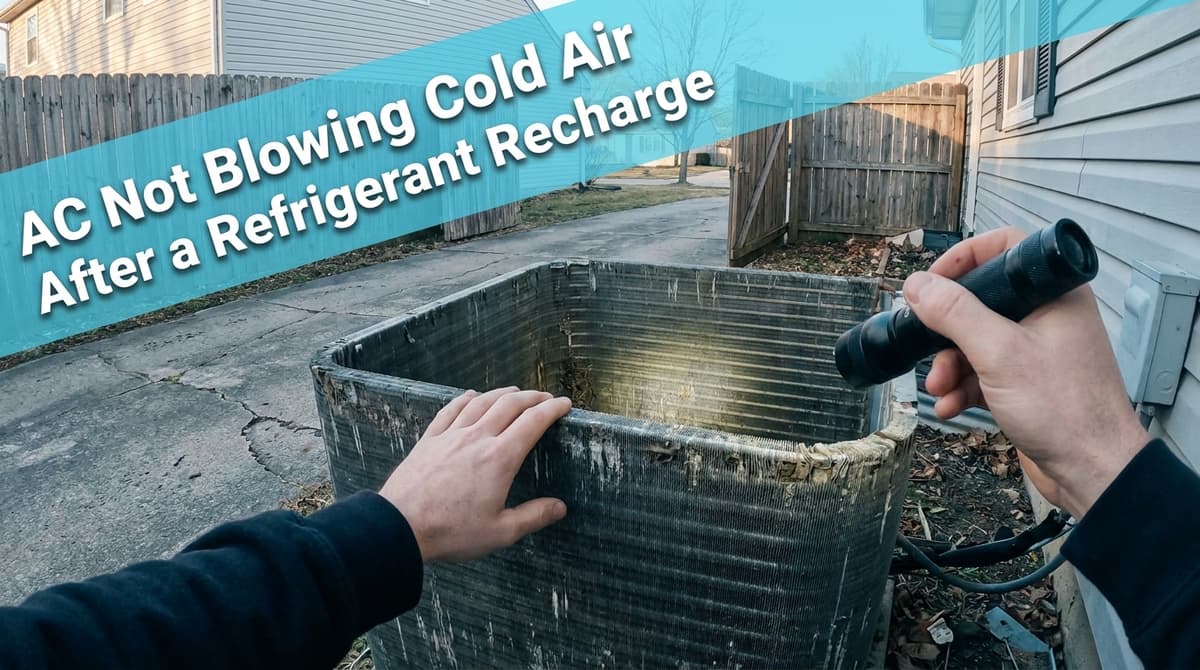
Your AC has two main coils: the evaporator coil inside and the condenser coil outside. If they’re dirty, your system can’t move heat effectively — even if the refrigerant level is perfect.
- Dirty outdoor coil (condenser): Covered in cottonwood fluff, grass clippings, or dirt, it struggles to release heat.
- Dirty indoor coil (evaporator): Often clogged with dust and debris after years of weak or missing filters.
Result: The system runs and runs, but the air coming out of the vents never feels truly cold.
2. Airflow Restrictions in the Home
Even with perfect refrigerant charge, your AC can’t cool properly if air can’t move through it. We often find:
- Clogged air filter (the most common issue by far)
- Closed or blocked supply vents (furniture, rugs, toys, boxes)
- Return grills covered by furniture or curtains
Restricted airflow can cause the coil to get too cold and even freeze over, which actually reduces cooling. Homeowners sometimes think they’re saving energy by closing vents in rooms they don’t use, but that can backfire and strain the system.
3. Failing Components Inside the System
Sometimes the refrigerant level is fine, but one of the major components is starting to fail:
- Weak compressor: The “heart” of the system can’t pump refrigerant effectively.
- Failing capacitor: The compressor or fan motors struggle to start or run at full speed.
- Indoor or outdoor fan issues: Fans not running, running slowly, or cycling on and off.
In Mark’s case, this is the kind of thing we always want to double-check on a callback visit: is the system actually moving refrigerant and air the way it should?
4. Ductwork Problems
We’ve gone into homes where the AC equipment is working fine, but the ducts are the real problem:
- Disconnected or crushed ducts in the attic or crawlspace
- Leaky ducts dumping cold air into the attic instead of the rooms
- Bad duct design that leaves some rooms starved for airflow
If cold air never makes it to your living spaces, a refrigerant recharge won’t change much.
5. Undersized or Overworked System
On very hot days, we sometimes find that the system is simply too small for the home, has a lot of west-facing glass, or poor insulation. The AC may run nonstop and still not keep up.
Recharging refrigerant won’t make an undersized unit magically bigger. In these cases, we talk with homeowners about insulation, air sealing, shading, and sometimes upgrading to properly sized equipment.
6. Ongoing Refrigerant Leaks
If the system needed refrigerant once and nobody found the leak, it’s likely to lose refrigerant again. Depending on the size and location of the leak, that can happen over months or even days.
So if you notice that cooling improved briefly after a recharge then got worse again, that’s a strong sign you need a proper leak check, not just another top-off.
What Homeowners Can Safely Check Themselves
Before you schedule a return visit — like Mark did — there are a few things you can safely check without tools:
- Air filter: Slide it out and look at it. If it’s gray and caked with dust, replace it. In peak season, we recommend checking monthly.
- Vents and returns: Make sure all supply vents are open and not blocked, and that return grills aren’t covered by furniture, rugs, or curtains.
- Outdoor unit: Clear away leaves, weeds, and debris at least 18–24 inches around the unit. Gently hose off grass clippings on the fins (with the power off).
- Thermostat settings: Confirm it’s set to Cool, the temperature is lower than room temp, and the fan is on Auto, not just On.
If you’ve checked these items and your AC still isn’t blowing cold air, it’s time for professional diagnosis.
When to Call an HVAC Professional
There are a few red flags that tell us homeowners should stop troubleshooting and pick up the phone:
- You’ve recently had a refrigerant recharge and there’s still little or no improvement.
- You see ice on the outdoor lines, the outdoor unit, or the indoor coil area.
- The breaker is tripping when the AC runs.
- You hear loud buzzing, grinding, or clicking from the indoor or outdoor unit.
- Certain rooms are much hotter than others, even with all vents open.
In those situations, continuing to run the system can actually cause more damage. A qualified technician can:
- Verify the refrigerant charge with proper gauges
- Check compressor and fan motor performance
- Inspect coils, drains, and wiring
- Test for refrigerant leaks and discuss repair vs. replacement options
Next Steps If Your AC Still Isn’t Cooling
If you’re in the same boat as Mark — your AC was just recharged but the air still isn’t cold — don’t assume you just need more refrigerant. That’s often a sign of a deeper issue that needs a thorough look.
Start with the simple checks (filter, vents, outdoor clearance). If everything looks good and you’re still uncomfortable, it’s time for a professional diagnosis so we can find why the system isn’t performing and give you options to fix it for good, not just for a day or two.
Staying ahead of these issues with regular maintenance visits can also catch a lot of these problems before they leave you sweating in the middle of a heat wave.