AC Running But House Still Hot? Common Causes & Fixes
AC running but your house is still hot? Learn common causes like a non-spinning outdoor fan and plenum or duct leaks, plus what you can safely check yourself.
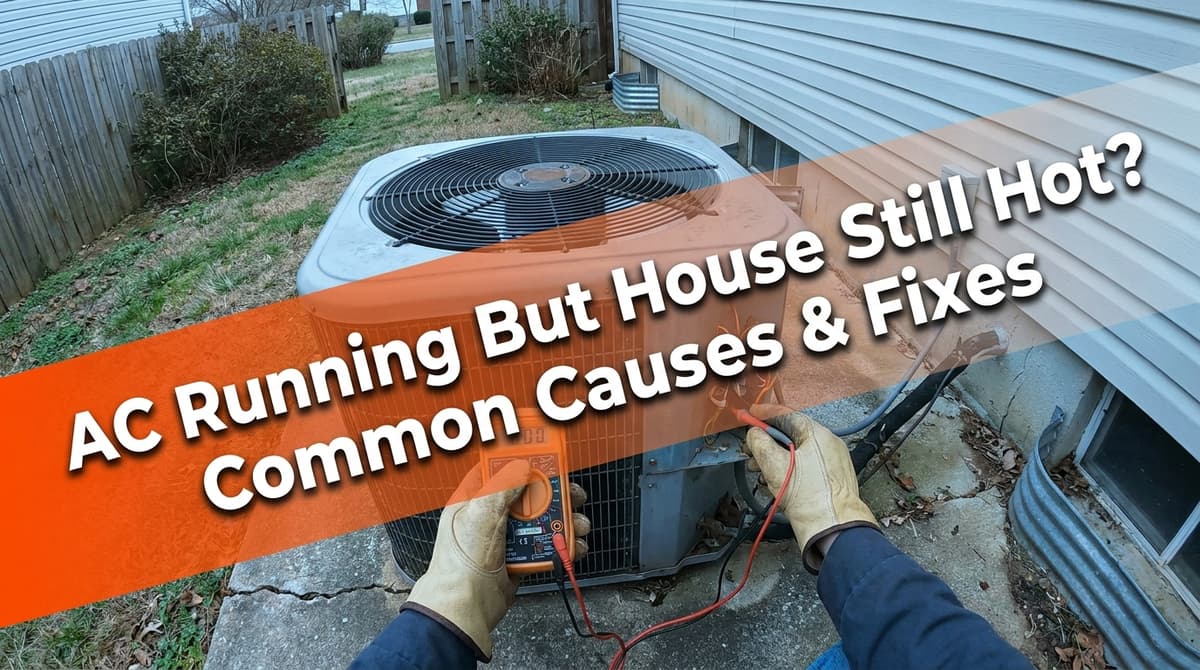
When Your AC Runs But the House Stays Hot
We recently got a call from a new customer — let’s call him Tyler — who was pretty frustrated with his air conditioner. He told us, “The thermostat’s set to 72, but when I walked in, it was 80 in the house. The system is on, the vents are blowing cold, but the house is still hot.”
Tyler and his dad are contractors, so he’d already taken a look around. He noticed something a lot of homeowners miss: the seal around the plenum (that big metal box or barrel-looking part your indoor unit blows into) had come loose. He taped it back up and it worked fine for a bit. Then the problem came back — and this time, a family member checked the outdoor unit and noticed the fan outside wasn’t spinning.
That combination — AC running, house hot, vents blowing some cool air, and an outdoor fan not spinning — is exactly the kind of puzzle we get called out to solve all the time. Let’s walk through what might be going on and what you can safely check before we arrive.
Why Your AC Can Run But Still Not Cool the House
When the thermostat says “cool” and you hear the system running, it’s easy to assume everything’s working. But your AC is really a team of parts working together. If one piece is struggling, you can end up with:
- Cool air at some vents, but not enough to drop the temperature
- Long run times with little or no change on the thermostat
- Hot and cold spots around the house
In Tyler’s case, there were two likely culprits: air leaking around the plenum in the attic and a non-spinning outdoor fan. Both are very common — and very fixable — causes of a hot house.
Common Cause #1: Outdoor Fan Isn’t Spinning
If someone walks by your outdoor unit and notices the fan on top isn’t spinning while the system is calling for cooling, that’s a big red flag. That fan’s job is to move hot air away from the outdoor coil. If it’s not doing that, your system can overheat and struggle to cool.
Possible causes include:
- Failed or weak capacitor: This is a common part that helps the fan motor start and run. When it fails, you might hear a humming noise, but the fan won’t turn.
- Bad fan motor: Over time, motors wear out, especially in the summer heat.
- Electrical issues: Loose connections, tripped breakers, or damaged wiring can all stop the fan.
What you can safely check:
- Check the breaker panel: Look for any tripped breakers labeled “AC” or “condenser.” If one is tripped, you can try resetting it once. If it trips again, stop and call a professional.
- Listen and look (from a distance): If the unit is humming but the fan isn’t spinning, do not try to push the fan with a stick or your hand. That’s a sign of a likely capacitor or motor problem that needs a technician.
What you should NOT do: Don’t open the electrical panel on the outdoor unit, don’t keep resetting a breaker that keeps tripping, and don’t try to “spin start” the fan. Those are safety and shock hazards and can cause further damage.
Common Cause #2: Plenum or Duct Leaks in the Attic
The other big clue Tyler gave us was in the attic: the seal around his plenum was broken all the way around. He did what many handy homeowners do — taped it up, and it worked better for a while. That told us a lot.
Your plenum is the large metal box or barrel-shaped piece the indoor unit blows air into before it goes out through your ducts. If the connection between the unit and plenum is loose, or if there are big gaps in the ducts, a lot of your cool air can dump into the attic instead of into your home.
Signs of plenum or duct leaks include:
- Vents that feel cool, but the house still won’t reach the set temperature
- Hotter rooms under attic spaces
- Visible gaps, separated joints, or old, peeling tape around ducts or the plenum
What you can safely check:
- Visual inspection: If you’re comfortable and it’s safe to access your attic, look around the indoor unit and plenum. Do you see obvious gaps or open seams where you can feel air blowing out?
- Feel for air leaks: With the system running, you may be able to feel strong air blowing into the attic from around loose joints.
Tyler used tape as a quick fix, which can work in a pinch, but for long-term reliability we recommend mastic and proper insulation rather than generic cloth or duct tape, which tends to dry out and fall off in a hot attic.
Other Simple Things to Check When the House Won’t Cool
Before you assume the worst, there are a few basic checks you can do that are safe for most homeowners:
- Air filter: Make sure it’s not clogged. A dirty filter restricts airflow and can cause the system to ice up or underperform.
- Thermostat settings: Confirm it’s set to “cool” and “auto,” not just “fan.” A fan-only setting will blow air but won’t cool it.
- Vents and returns: Make sure supply vents and return grilles aren’t blocked by furniture, rugs, or closed doors.
- Indoor unit access panel: Check that the main panel is fully in place and screwed on; if it’s loose or off, a safety switch can stop the blower.
When to Call in a Professional
If you’ve checked the basics and you still have:
- A non-spinning outdoor fan
- Repeated breaker trips
- Obvious duct or plenum damage you’re not comfortable sealing
- A system that runs for hours without dropping the temperature
it’s time to have a technician out. In Tyler’s case, we were able to get him on the schedule same-day after a cancellation, walk through what he’d already tried, and then safely test the electrical components and refrigerant system.
We always encourage homeowners to do the simple, safe checks first — thermostat, filter, breakers, obvious air leaks. But when you’re dealing with high voltage, refrigerant, or motors that aren’t starting, that’s where our tools, training, and testing equipment really matter.
If your AC is running and your house still feels like it’s stuck at 80 degrees, you’re not alone, and you’re not overreacting by calling for help. The sooner we track down issues like a non-spinning outdoor fan or a leaking plenum, the easier (and often cheaper) they are to fix.