AC Running but Not Blowing Air? Common Causes & Fixes
AC running but not blowing air? Learn the most common causes, safe DIY checks you can try first, and when it’s time to call an HVAC pro.
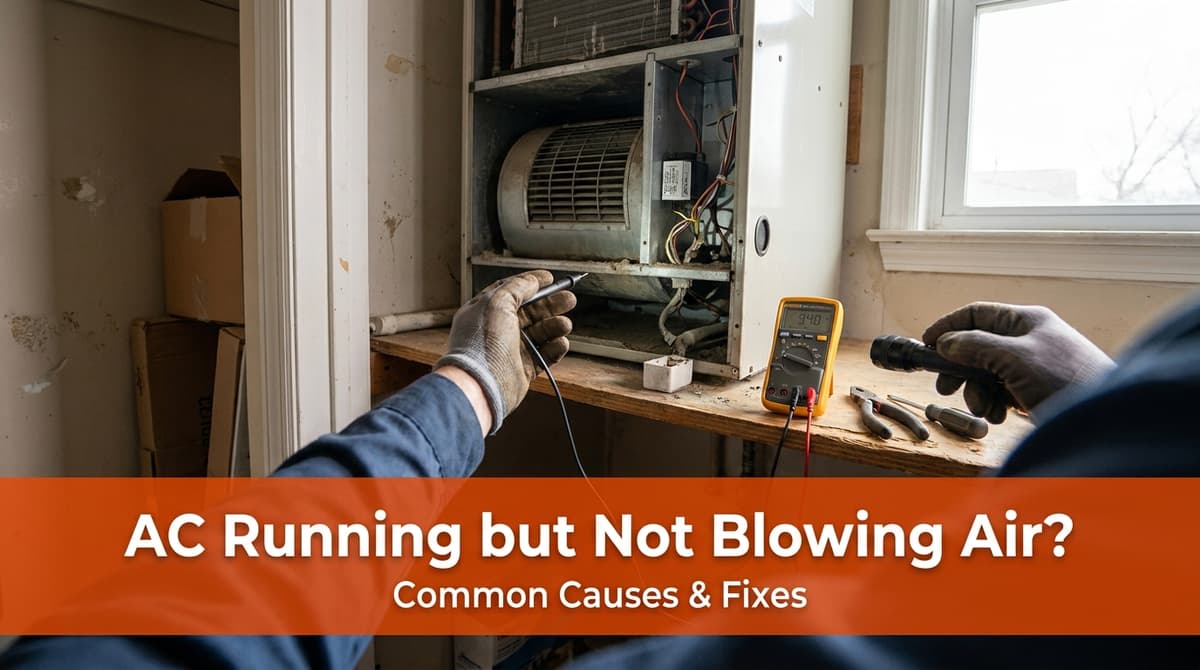
“It’s On, But Nothing’s Coming Out” – A Call We Hear A Lot
We recently got a call from a homeowner — let’s call him Jason — who sounded pretty frustrated. “My AC is running but it’s not blowing any air,” he told us. “I changed the filter, I reset the breakers… I’m just hoping it’s nothing major.”
We hear some version of Jason’s situation a lot. From our side of the phone, we’re mentally running through a checklist before we even arrive: is the blower running, is there ice on the system, did something electrical trip, or is the ductwork the culprit? In many cases, there are a few simple checks homeowners can safely try before we need to roll a truck.
In this post, we’ll walk you through how we think about this problem on service calls, the common causes we see, a few DIY checks you can do, and when it’s time to call in an HVAC pro.
First Step: Is the System Really “Not Blowing”?
When someone calls us and says, “It’s not blowing,” we start by asking a couple of clarifying questions, just like we did with Jason:
- Do you hear anything inside? A humming, whirring, or rattling from the indoor unit?
- Do you feel even a little airflow at any supply vents? Sometimes air is moving, just very weakly.
- Is the outdoor unit running? Can you hear the fan and compressor outside?
Your answers help us narrow things down. As a homeowner, you can do the same quick check:
- Set your thermostat fan to “On” instead of “Auto.” If the blower is healthy, you should feel air at the vents even if cooling isn’t running.
- Listen at the indoor unit (usually in a closet, attic, basement, or garage). Silence often means a blower or control issue; humming with no airflow can point to a failed blower motor or capacitor.
Common Causes We See When AC Runs but No Air Blows
On real-world calls like Jason’s, we usually find one of a handful of issues. Here are the ones we run into most often:
1. Blower Motor or Capacitor Failure
The blower motor is the indoor fan that pushes air through your ducts. If it fails, the system can still “come on” (thermostat clicks, outdoor unit runs), but no air moves inside. We also frequently find a bad capacitor — a small part that helps the motor start.
What we notice on site:
- Indoor unit humming but fan wheel not spinning.
- Motor hot to the touch, or tripping internal overload.
- Burnt smell from the air handler or blower compartment.
DIY level: Identifying a dead blower is often straightforward, but replacing a motor or capacitor is not a safe DIY project. It involves live electrical work and proper sizing. This is where we strongly recommend calling a pro.
2. Clogged Filter or Coil Choking Off Airflow
Jason had already done what we always recommend first: he changed the filter. We wish everyone did that before they called us. When filters are neglected, we see them collapse, get sucked into the duct, or allow dust to plug the indoor coil (the cold “A-coil” above your furnace or inside the air handler).
What you can check safely:
- Make sure the new filter is the correct size and installed in the right direction (arrow pointing toward the furnace/air handler).
- If your filter is inside a return grille, ensure nothing is blocking the grille (furniture, rugs, boxes).
- Shine a flashlight through the old filter you removed – if almost no light passes through, it was badly clogged and your coil may need a professional cleaning.
If the coil is iced up or packed with dust, it can cut airflow to almost nothing. In those cases, we shut the cooling off, often run the fan to thaw and dry the coil, and then clean it properly.
3. Frozen Indoor Coil
Another thing we see on warm days is a frozen coil. Ironically, ice can completely block airflow. The outdoor unit may be humming along, but inside you get little to no air at the vents.
Signs we look for (you can check these too):
- Ice on the refrigerant lines near the indoor unit.
- Water around the indoor unit after the system has been off for a while (melted ice).
- Very weak airflow before it stops completely.
Safe DIY step: Turn the cooling OFF at the thermostat, set the fan to “On”, and let it run for a few hours to thaw the coil. If it refreezes once you try cooling again, there’s an underlying issue (low refrigerant, dirty coil, restricted airflow, or a control problem) and it’s time for us to come out.
4. Ductwork Problems or Closed Vents
Every season we find at least a few homes where the AC is running but no air blows because the ducts are compromised. In attics and crawlspaces, we see:
- Disconnected or fallen flex duct.
- Crushed or kinked duct runs.
- Manual dampers shut off to certain areas.
Inside the home, we sometimes discover that many supply vents are closed or blocked. That doesn’t usually kill airflow everywhere, but it can make it feel like “nothing’s coming out.”
What you can safely check:
- Make sure all supply vents are open and unblocked (no furniture, curtains, or rugs covering them).
- If you can safely see into an accessible attic or basement, look for obvious disconnected ducts near the indoor unit — but don’t climb into unsafe spaces.
5. Thermostat or Control Issues
Sometimes, like we’ve seen on a few calls similar to Jason’s, the problem isn’t the blower at all — it’s the thermostat or control board not telling the blower to run.
Simple checks you can do:
- Verify the thermostat is set to Cool, temperature is set lower than room temperature, and the fan is set to “On” or “Auto.”
- If your thermostat uses batteries, replace them even if it’s still lit.
- Check that the thermostat screen isn’t displaying an error or “Wait” message for long periods.
If everything looks normal but your indoor fan never comes on (and the outdoor unit does), we usually need to test low-voltage circuits and the control board — that’s pro territory.
DIY Checks We Recommend Before You Call
When we’re on the phone with someone like Jason, we often walk through a quick, safe checklist. Here’s the version we’re comfortable recommending for most homeowners:
- Change or confirm the air filter. Make sure it’s clean, properly sized, and installed correctly.
- Check the thermostat settings. Cool mode, temperature set low enough, fan “On” or “Auto,” fresh batteries if applicable.
- Set fan to “On” and test for airflow. If the blower is healthy, you should feel something at the vents even without cooling.
- Check the breakers once. Confirm both the indoor and outdoor unit breakers are on; if a breaker has tripped more than once, do not keep resetting it.
- Look and listen around the indoor unit. Note any ice, water, burnt smells, loud humming, or rattling.
If any of these steps restores airflow, great — you may have caught a small issue early. If not, the information you gathered helps us diagnose faster when we arrive.
When It’s Time to Call an HVAC Pro
From our experience on calls like Jason’s, here’s when we recommend you stop troubleshooting and bring in a professional:
- You’ve checked the filter and thermostat, and there is still no or very weak airflow.
- You hear the indoor unit humming but the fan won’t spin, or you smell something burnt.
- You see ice on the lines or coil that keeps coming back after thawing.
- A breaker trips again after you reset it once.
- You suspect a duct has come loose in the attic, crawlspace, or basement.
On our end, we’ll check electrical components, measure motor amperage, inspect the coil, verify airflow, look for duct issues, and test refrigerant pressures as needed. The goal is the same one Jason had on the phone with us: keep the repair as minor as possible and get cool air blowing again quickly.
If your AC is running but not blowing air, and you’ve gone through the basic checks, we’re here to take it from there. We see this problem all the time, we know the usual suspects, and we’ll track down the cause so your home can be comfortable again.