Why Your AC Won’t Turn On in an Older Building
AC won’t turn on in an older building? Learn the safe checks you can do for breakers and switches, plus how we fix and prevent “mystery switch” AC problems.
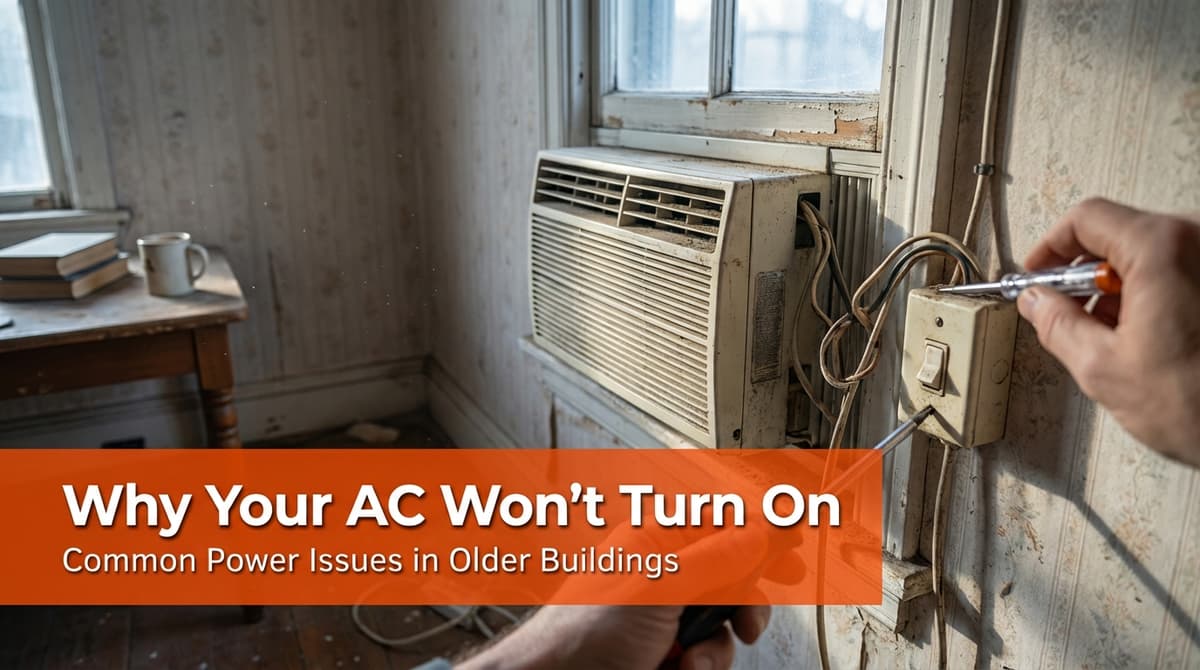
When an Older Building’s AC Suddenly Goes Silent
We recently got a call from a property manager — we’ll call her Rachel — about an older building on a busy town square. Her tenant said the AC/heat unit wouldn’t kick on at all. No cooling, no heat, and not even the fan was coming on.
Right away, that told us one big thing: if the fan isn’t even trying to start, there’s a good chance the system simply isn’t getting power. As Rachel explained more, she mentioned something we hear a lot with older buildings: “There’s a switch on the roof that somehow sometimes gets shut off.” The tenant had tried a few things already, but nothing worked.
Situations like Rachel’s are common in older homes and commercial buildings. There are often mystery switches, quirky breaker panels, or rooftop disconnects that can shut everything down. In this post, we’ll walk you through what we talk customers through on the phone — and what you can safely check before you call an HVAC pro.
Why AC Systems in Older Buildings Lose Power
In older buildings, the AC rarely has just one simple on/off point. Over the years, different electricians and contractors may have added panels, switches, and disconnects. That’s how you end up, like Rachel, with a key switch on a roof near a marquee sign that controls the AC.
When we arrived at Rachel’s building, we saw exactly that: an older package unit on the roof with an exterior disconnect box and a nearby switch that had been used at some point for sign power and seasonal AC control. One of those switches had been flipped off, and the unit was completely dead — no fan, no compressor, nothing.
We see a few common power and switch issues in older buildings:
- Hidden or unlabeled rooftop disconnects that someone accidentally shuts off while working outside.
- Old-style toggle switches inside back rooms or closets that kill power to the unit.
- Multiple breaker panels (sometimes added over decades) where the AC breaker is easy to miss.
- Shared circuits with signage or other equipment that get turned off for maintenance.
In Rachel’s case, once we traced the power and reset the correct switch and disconnect, the unit came right back to life. Then we tested everything to be sure there wasn’t a deeper electrical or equipment issue hiding underneath.
What We Walk Customers Through Before a Service Call
There are a few things we routinely walk folks through over the phone when their AC won’t turn on — all simple, safe checks you can do yourself. These quick steps sometimes save you a service call, especially if the problem is just a flipped switch like Rachel’s tenant ran into.
1. Check the thermostat (it really can be that simple)
We always start inside:
- Confirm it has power. Is the screen on? If it’s blank, your thermostat may need batteries or may have lost its power source.
- Set to “Cool” or “Heat” and “Auto” or “On.” Make sure it didn’t get bumped into “Off” or “Fan Only.”
- Lower or raise the setpoint. Set it 3–5 degrees below (for cooling) or above (for heating) the current room temperature and wait a minute to see if anything starts.
If the thermostat is powered and correctly set but you hear absolutely nothing from the indoor or outdoor unit, that’s when we start thinking more seriously about a power issue.
2. Safely check your breaker panel
The next step we walk customers through is the breaker panel. Here’s how we suggest doing it safely:
- Find the right panel. Older buildings can have more than one. Look in basements, back halls, utility rooms, or near the meter.
- Look for breakers labeled “AC,” “A/C,” “Furnace,” or “Air Handler.” Labels might be faded or wrong in older panels, so check any that look like likely candidates.
- Look for a breaker that’s between ON and OFF. A tripped breaker often doesn’t look fully off.
- Reset safely: Push the breaker all the way to OFF, then firmly back to ON.
If the breaker immediately trips again, stop there. That usually means there’s a deeper electrical or equipment problem, and that’s where we strongly recommend calling a licensed HVAC pro. In Rachel’s building, the breakers were fine — which told us the problem had to be further downstream at a disconnect or switch.
3. Look for obvious, accessible switches
Older buildings often have extra switches controlling the furnace, air handler, or outdoor unit. On the phone, we’ll ask questions like:
- “Do you see a regular light switch near the indoor unit, on the ceiling, or beside the unit?”
- “Is there a switch box or lever next to the outdoor AC, usually in a small metal or plastic box?”
Here’s what you can safely look for:
- Indoor “service” switch: Often looks like a normal light switch on or near the furnace/air handler. Make sure it’s flipped up/on.
- Outdoor disconnect box: A small box near the outdoor unit. Many have a pull-out handle inside. You can open the cover and see if the handle is firmly seated and fully in. If you’re unsure or uncomfortable, leave it and give us a call.
In Rachel’s case, the key clue was her mention of the roof switch by the marquee sign. Because that switch was in a hard-to-reach spot on the roof, we didn’t talk her tenant through that part — our technician handled it on-site with proper safety precautions.
Safety First: What Not to Do
We want you to be able to do simple checks, but we also want you safe. Here’s what we never recommend homeowners or tenants do:
- Don’t open electrical panels beyond the breaker door.
- Don’t remove covers from the AC unit, furnace, or rooftop disconnects.
- Don’t climb onto a roof or ladder if you’re not fully comfortable and equipped to do it safely.
- Don’t keep resetting a breaker that keeps tripping — that’s a sign to stop and call a pro.
On Rachel’s job, our technician used fall protection on the roof, properly tested for power with a meter, and checked the wiring inside the disconnect before restoring power. Once everything was verified safe, we turned the system back on and watched a full cycle to be sure there were no hidden issues.
How We Prevent Repeat “Mystery Switch” Problems
Once we fix a no-power issue like Rachel’s, we try to make sure our customer doesn’t end up in the same spot next season. With older buildings especially, we like to:
- Label switches and disconnects clearly so it’s obvious what they control.
- Add tags or stickers near the thermostat or panel explaining which breaker runs the AC.
- Recommend a seasonal checkup in spring or fall to make sure everything powers up correctly before extreme weather hits.
For Rachel, we labeled the rooftop switch and the disconnect by the unit and walked her through what we’d found. That way, if someone’s working near the marquee in the future, they’ll know not to flip that switch off without understanding what it does.
Quick Checklist You Can Screenshot
Here’s the same simple checklist we mentally ran through with Rachel’s tenant — you can screenshot this for later:
- Is the thermostat on, set to the right mode, and set several degrees below/above room temp?
- Do you hear anything from the indoor or outdoor unit when it calls for cooling or heat?
- Have you checked the main breaker panel for a tripped “AC,” “Furnace,” or “Air Handler” breaker and safely reset it once?
- Is there a light-switch-style control near the furnace/air handler, and is it in the ON position?
- Do you see an outdoor disconnect box, and does the handle appear fully seated and in?
- If all of the above look normal and the system is still dead, it’s time to call an HVAC pro.
If your situation sounds like Rachel’s — an older building, a dead-silent AC, and maybe a few “mystery switches” around — we’re happy to help. We troubleshoot these kinds of power and switch issues every season, and we’ll not only get you running again but also help make the system easier to understand going forward.