Why Half Your Home Lost Power After Generator Work
Half your house just lost power after generator work? Learn why outlets, AC, and your well pump can all stop at once and what to safely check before calling us.
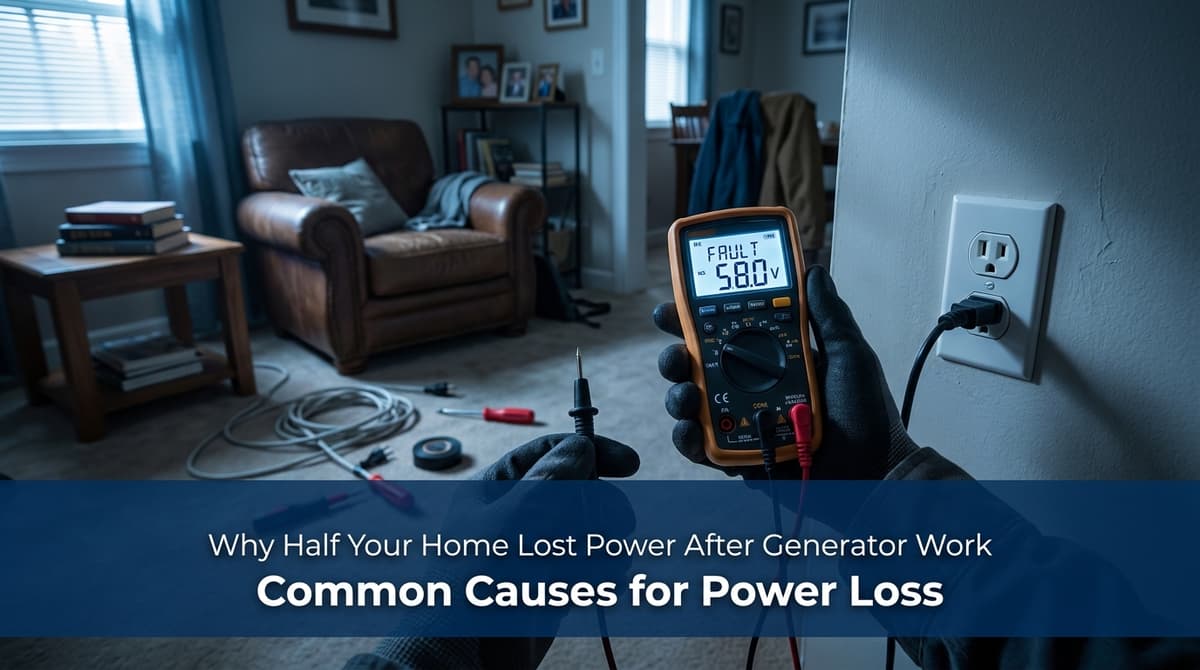
When Half Your Home Suddenly Loses Power
We recently got a call from a homeowner — let’s call her Debbie — who had just driven home from a long trip. As she walked through the house, she realized something was very wrong. About half of her outlets didn’t work, several light switches did nothing, none of her window air conditioners would turn on, and even her well pump was dead.
On top of that, she told us there had been a Generac standby generator installation in progress outside. The installers hadn’t finished yet, and she was wondering if that work could be the reason so much of her home suddenly lost power.
We hear some version of Debbie’s story a lot. When generator work, partial power loss, and critical equipment like AC and well pumps all show up in the same sentence, our electricians’ ears perk up. In this post, we’ll walk through how situations like this happen, how we usually diagnose them, and what you can safely check before we arrive.
Why Only “Half” the House Loses Power
When someone tells us “about half” the outlets and lights are out, our minds immediately go to how a typical home is wired.
Understanding Your Two Hot Legs
Most homes in our area have split-phase 240V service. In plain English, that means you have:
- Two “hot” legs of power coming from the utility (often called Leg A and Leg B)
- One neutral wire
- Grounding conductors
Your breaker panel is laid out so that some circuits land on Leg A and some on Leg B. If you lose one leg for any reason, everything on that leg goes dark, while circuits on the other leg may still work. That’s why it can look like only half the house is dead.
Why ACs and Well Pumps Are First to Be Noticed
In Debbie’s case, we immediately paid attention to two things:
- All of her ACs were out
- Her well pump was out
Central AC condensers, mini-splits, window units, and well pumps are often on 240V or dedicated 120V circuits that sit on specific legs. If the leg feeding those breakers is lost or disconnected, the equipment simply won’t run — even if some lights or outlets in the home still work.
How Generator Work Can Affect Your Power
When a standby generator is installed, the electrician typically adds a transfer switch or a generator-ready panel. All of that work involves your main service conductors, hot legs, and neutral — the critical pathways that feed your entire home.
Loose or Disconnected Hot Leg
One of the most common issues we see after generator work is a loose or improperly landed hot leg. If one of those two hot legs isn’t securely connected at the transfer switch or panel, you can end up with:
- Roughly half your breakers not getting full power
- Some 240V loads (like AC or well pumps) completely dead
- Other 120V circuits working just fine
This can happen if the work is mid-project and the system isn’t fully buttoned up, or if a lug wasn’t tightened correctly. It’s one of the first things our electricians check when we hear a story like Debbie’s.
Transfer Switch Wiring Issues
Another possibility is a miswired transfer switch. If the conductors feeding the “generator” side and the “utility” side of the switch aren’t landed correctly, you can get:
- Power on only one side of the bus in your panel
- Certain circuits never picking up power in either normal or generator mode
- Strange behavior when switching between utility and generator
In one recent case, we’ll call that homeowner Mark, we arrived to find that only the kitchen and one bedroom had power after a transfer switch install. Our team traced it back to one incoming hot leg not being properly transferred through the new equipment. Once we corrected the wiring and tested under load, the rest of the house came back to life.
Neutral Problems: Flickering and “Ghost” Power
While Debbie’s situation sounded like a clean loss of one leg, we also watch for neutral issues. A loose or disconnected neutral can cause:
- Lights brightening and dimming randomly
- Electronics behaving erratically
- Some outlets measuring voltage but not properly powering loads
In another home, we’ll call that customer Tom, we found that a neutral conductor wasn’t properly terminated when a generator subpanel was added. His lights were surging and his refrigerator sounded wrong. That kind of problem is more than an inconvenience — it’s a risk to your appliances and electronics.
What We Walk You Through on the Phone
When you call us with a story like Debbie’s, we’ll ask a few quick questions and guide you through some basic, safe checks before we roll a truck.
Simple Checks You Can Do Safely
- Ask about the generator status: Is the generator installation complete, or mid-project? Is the transfer switch in “Utility” or “Off” position?
- Look (don’t touch) at the main panel: We may ask you to open the panel door (not the deadfront cover with the screws) and tell us if any breakers, including the main, appear tripped.
- Try a full breaker reset: For a suspect breaker, flip it firmly all the way off and then back on. Sometimes a partially tripped breaker doesn’t look obviously off.
- Note what works vs. what doesn’t: We’ll ask you to list which rooms or big appliances have power and which don’t. The pattern often tells us if one leg is missing.
We never ask you to remove panel covers, stick tools into outlets, or expose any wiring. Anything involving live conductors inside a panel is our job, not yours.
When to Shut the Main Off and Wait
There are times when, based on your answers, our advice is simple: turn off the main breaker and wait for us. We recommend this if:
- You smell burning or see scorch marks near the panel or transfer switch
- Lights are rapidly brightening and dimming all over the house
- Multiple large appliances (like AC, fridge, well pump) are trying to start and failing repeatedly
In those situations, protecting your wiring and equipment — and your safety — is more important than trying to keep partial power on. We can usually prioritize these calls as urgent.
How Our Electricians Diagnose Partial Power After Generator Work
When our team arrives for a call like Debbie’s, we follow a step-by-step process to track down the problem quickly and safely.
Our On-Site Diagnostic Steps
- Verify utility power: We check incoming voltage from the meter to ensure both hot legs and the neutral are present and at the right levels.
- Inspect the transfer switch or generator panel: We look for loose connections, miswired conductors, or mechanical issues inside the switch.
- Test each leg at the main panel: Using a meter, we confirm each leg is delivering proper voltage to the bus and to key breakers.
- Check critical loads: We trace circuits feeding your AC, well pump, refrigerator, and other essentials to confirm they’re properly connected and protected.
Once we find the root cause — whether it’s a loose lug, miswired transfer switch, bad breaker, or an issue with the utility feed — we correct it, test under load, and walk you through what we found.
What You Should Do If This Happens at Your Home
If you come home and discover that half your outlets are dead, the AC won’t run, and your well pump won’t start — especially after recent generator work — here’s what we recommend:
- Don’t ignore it. Partial power is a sign something isn’t right with your service, panel, or transfer equipment.
- Don’t tear into the panel yourself. The main lugs feeding your panel are always live, even with the main breaker off.
- Call a licensed electrician who works with generators and transfer switches regularly.
- Let us know about any recent electrical work (generator, panel upgrade, meter change). That detail helps us zero in faster.
Our technicians work with standby generators, transfer switches, and well and HVAC circuits every day. When we hear a story like Debbie’s — half the house out after generator work — we know exactly where to start, and we’re ready to get your lights, AC, and water back on safely.