Why One HVAC Zone Fails After Another Is Repaired
Upstairs hot but downstairs just got fixed? Learn why one HVAC zone can fail right after another repair and what to check before calling for service again.
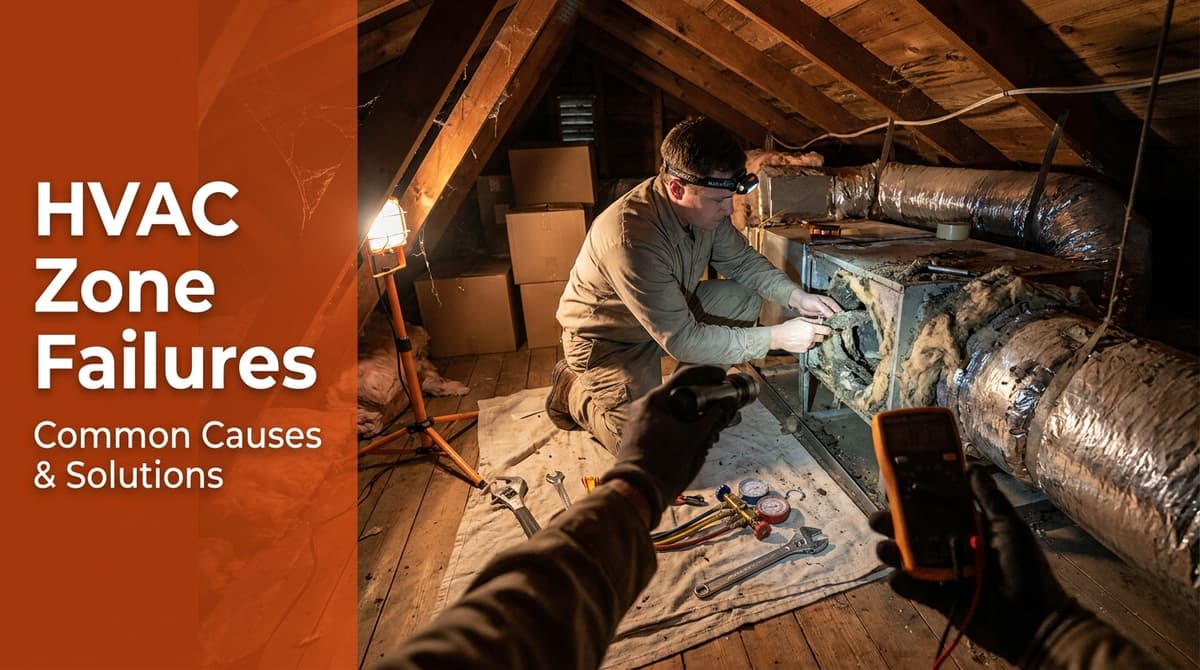
When Fixing One HVAC Zone Seems to Break the Other
We recently got a call from a customer — let’s call her Linda — who was more than a little frustrated, and honestly, we understood why.
We had been out to her home on a Saturday for an emergency visit because her downstairs air conditioner wasn’t working. Our technician got that system up and running, and everything seemed fine when he left. The upstairs system was working normally at that time.
A day later, Linda went upstairs and was hit with a wall of heat. Her upstairs system wasn’t blowing any air at all — not warm, not cool, nothing. She could tell there was power to the unit, but the blower just wasn’t moving air. On top of comfort concerns, she stores a lot of cream makeup and skincare upstairs and was worried the heat would ruin it.
Her big question for us was one we hear a lot: “Why did one HVAC zone stop working right after you fixed the other?”
Two Systems, Two Problems: Why It’s Not Always Connected
In Linda’s case, like many two-story homes, she had two separate HVAC systems — one dedicated to the downstairs and one to the upstairs. That’s different from a single system with zoning dampers.
This setup is important to understand, because when you have two distinct units, a repair on one typically doesn’t “cause” a failure in the other. They:
- Have separate outdoor condensers and indoor air handlers/furnaces
- Use independent thermostats
- Often are different ages and conditions
So when one fails right after the other is repaired, it usually feels connected — but most of the time, it’s actually coincidence plus timing. That said, there are a few patterns we see over and over.
Common Reasons One Zone Quits After Another Is Repaired
Here are some of the most common causes we explain to homeowners in situations like Linda’s.
1. Both Systems Are the Same Age
In many homes, the upstairs and downstairs units were installed together. That means:
- They’ve had the same number of years of wear and tear
- They share the same installation practices and brand quirks
- They often start failing within months of each other
So when one finally needs an emergency Saturday repair, it’s not unusual for the other to be right behind it. That’s probably not what Linda wanted to hear, but it’s often the reality with 12–20-year-old systems.
2. Hidden Problems You Don’t Notice Right Away
Another factor is simple awareness. Linda told us she hadn’t gone upstairs until the next day, so she only discovered the problem later. With less-used areas of the home (bonus rooms, guest rooms, storage spaces), it’s common to only realize there’s an issue after temperatures spike.
In those cases, the upstairs unit may have already been struggling or failing, but because no one was up there, it went unnoticed until after the downstairs repair.
3. Shared Power or Thermostat Issues
Occasionally, there is a link. In some homes, systems might share:
- A common power source or breaker box
- A low-voltage transformer feeding controls
- Wiring runs that can be bumped or loosened during other work
For example, if a transformer is overloaded or a low-voltage wire gets damaged, the thermostat for one system may stop calling for cooling or the indoor blower might not receive the signal to start. That can lead to a situation where the system has power, but no air is blowing — exactly what Linda’s husband reported.
4. Blower or Control Board Failures
When a unit has power but no airflow, three usual suspects are:
- Blower motor failure (motor is seized, bearings worn out, or internal winding failed)
- Blower capacitor failure (the motor can’t start turning without that “boost”)
- Control board issues (the system isn’t sending the start signal to the blower)
These components can fail from age, heat, or electrical issues, and the timing can be purely coincidental with another repair in the house.
What You Should Check Before Calling for Service
While we’re always happy to come out, there are a few things homeowners can safely check before scheduling another visit — especially if, like Linda, you’re worried about another service fee.
- Check both thermostats. Make sure each one is set to Cool, the temperature is below room temp, the fan is on Auto, and the display is on (fresh batteries if needed).
- Check your breakers. Look for any tripped breakers labeled A/C, air handler, or furnace. Flip fully OFF, then back ON once.
- Check the air filter for that specific system. A severely clogged filter can cause overheating and safety shutdowns.
- Listen for the indoor unit. If you hear a hum but no airflow, that’s a strong clue the blower motor or capacitor is the problem.
If all of that looks normal and you still have no airflow from one zone, it’s time for a technician.
Why There’s Usually a Separate Service Call Fee
One question Linda had — and it’s completely fair — was about the second service charge. From a homeowner’s point of view, it feels like “the same problem” because both zones affect the comfort of the home.
From a technical standpoint, though, separate systems mean:
- We have to diagnose a completely different unit
- It often requires different parts, tools, and testing
- It takes more time on site, even if it’s at the same address
That’s why most HVAC companies, including ours, charge a service fee per system. It covers the technician’s time to thoroughly evaluate that particular unit, not just the trip to your home.
How to Protect Yourself From Surprise Zone Failures
There are a few ways to reduce the odds of finding a hot upstairs or freezing-cold downstairs at the worst possible moment:
- Schedule regular maintenance for both systems — ideally in spring for cooling and fall for heating.
- Have the technician check both units while they’re already there, even if only one is acting up.
- Plan ahead for replacement if your units are the same age and approaching 12–15 years. Sometimes it’s smarter financially to replace them closer together.
- Use and test both zones regularly, even if you don’t spend much time upstairs.
In Linda’s case, we arranged to have a manager out between 3:30 and 4:30 so either she or her husband could be home, and we walked them through exactly what we’d be checking on that upstairs system.
When One Zone Fails, Don’t Wait on the Other
If you’ve just had a repair on one HVAC zone and notice issues with the other — especially no airflow, hot upstairs, or constant running — don’t ignore it. The sooner we identify whether it’s a minor electrical component, a blower issue, or a bigger problem, the more options you’ll have to protect both your comfort and your belongings.
And if you’re ever unsure whether it’s a true emergency (like Linda worrying about expensive products melting upstairs), just give us a call. We’ll talk through what you’re seeing and help you decide the best next step.