Leaking Mini-Split: Replace the Coil or the Whole Head?
Leaking mini-split head? Learn when it makes sense to replace just the coil, swap the entire indoor unit, or plan for a full system in light of the R‑410A phase-out.
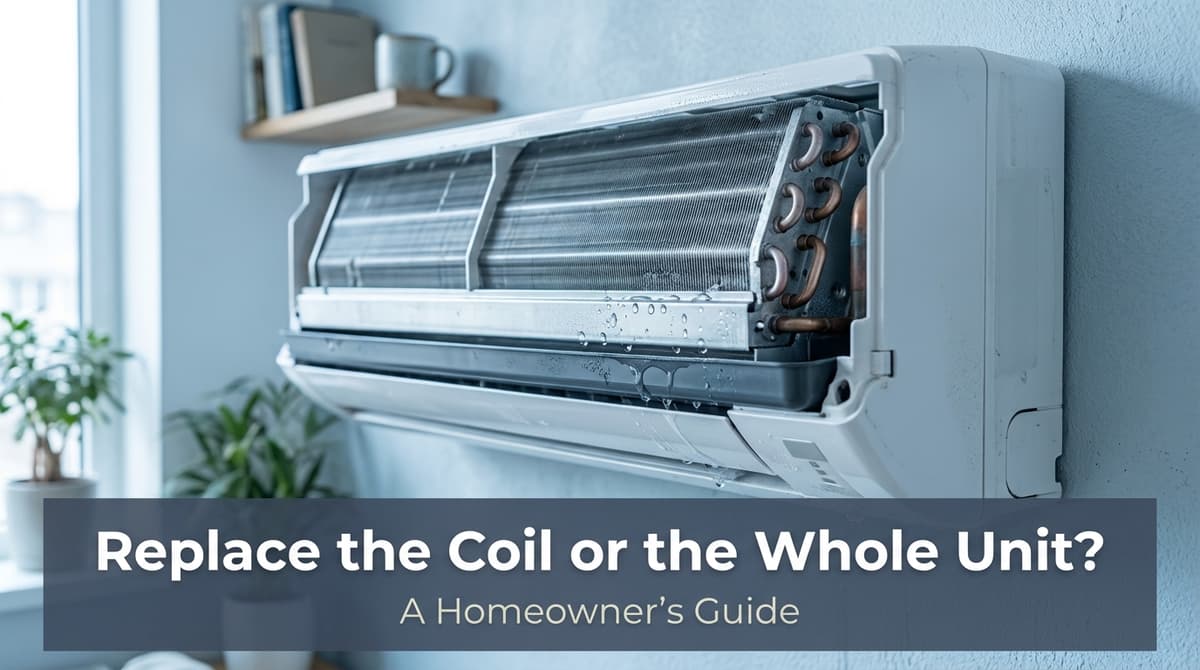
When a Mini-Split Head Starts Leaking: Coil or Full Replacement?
We recently got a call from a homeowner — let’s call him Brian — about a sunroom that just wouldn’t stay cool anymore. He had a Fujitsu mini-split serving that space, and a different contractor had already been out to diagnose the problem: the indoor coil in the wall-mounted head unit was leaking.
When Brian saw the quote to replace just the coil, the cost felt “kind of crazy” to him. So he did what a lot of handy homeowners do: he went to an HVAC supply house and bought an identical replacement indoor head unit himself — same brand, same model number — and then called us to install it and recharge the system.
We see this situation often enough that we’ve developed a pretty clear way we walk homeowners through the decision. When your mini-split head is leaking, should you replace just the coil, the entire indoor head, or bite the bullet and plan on a full system replacement — especially now that R‑410A is being phased out? Here’s how we look at it on real jobs.
What’s Actually Leaking? Coil vs. Head vs. Whole System
On Brian’s call, the other technician had done the hard part for us: they had already confirmed the leak was in the indoor evaporator coil, not the outdoor unit and not just a loose flare fitting. That matters a lot in how we advise people.
Inside a typical wall-mounted mini-split head, you’ve got:
- Evaporator coil – thin copper tubes and aluminum fins where refrigerant absorbs heat.
- Blower fan and motor – moves air across that coil into your room.
- Electronics and sensors – the “brains” of the head unit.
- Drain pan and line – carries away condensate water.
When we diagnose a leak, we want to know if it’s:
- At a connection (flare fitting, braze joint) – often repairable without major parts.
- Inside the coil itself – usually from corrosion, manufacturing defect, or physical damage.
- Elsewhere in the system – outdoor unit coil, line set, or service valves.
In Brian’s case, it was definitely the coil inside the indoor head. Once we’re there, we walk through options very honestly, because each choice has cost and lifespan trade-offs.
Option 1: Replace Just the Leaking Coil
Technically, we can replace just the evaporator coil in many mini-split heads. But when we put our installer hats on, here’s what we know from experience:
- It’s labor-intensive. We have to safely recover refrigerant, disassemble the head on the wall or bench, swap the coil, reassemble, pull a deep vacuum, then weigh in the charge.
- It’s finicky work. There’s a lot of tiny plastic clips, wiring harnesses, and tight copper connections that all have to go back exactly right.
- You’re still left with a head whose other parts are the same age (fan motor, drain pan, plastics, electronics).
Because of all that, the labor portion for a coil-only replacement can sometimes get within shouting distance of simply hanging a brand-new head. On many jobs we see:
- Coil-only repair: often in the mid- to higher-range of a typical repair bill, depending on access and brand.
- Full new head install: parts cost more, but labor is often simpler and faster.
We usually suggest coil-only replacement when:
- The system is fairly new and under parts warranty, so the coil cost is covered and you’re just paying labor.
- The exact replacement head isn’t available anymore, but the coil still is.
- The homeowner is trying to keep a matching set for aesthetic or control reasons.
Option 2: Replace the Entire Indoor Head Unit
Brian took the path we often recommend once a system is out of warranty: skip the coil and replace the whole indoor head. From our side of the tool bag, this makes a lot of sense when:
- The unit is 4–8 years old and out of its manufacturer warranty.
- You can still get an identical or fully compatible head that matches your outdoor unit and refrigerant type.
- The outdoor unit is still running strong with no red flags (no strange noises, no repeated pressure trips, etc.).
Here’s what we like about full head replacement:
- You get all-new components inside that room: fresh coil, fan, electronics, sensors, and plastics.
- The install is usually less time-consuming than a coil tear-down, which keeps labor more reasonable.
- We can set the new head up on the wall, pull a proper vacuum, pressure test, and recharge correctly, giving you a sort of “reset” for that zone.
On real jobs, when we compare line items, replacing the whole head usually runs somewhere in the moderate repair range to the low end of a new-system price, depending on brand, size, and how much refrigerant we have to add. That’s often easier for homeowners to swallow than paying almost as much labor just to keep an aging head alive.
Where R‑410A Phase-Out Fits Into the Decision
During Brian’s call, he mentioned something we’re hearing more and more: his system uses R‑410A, and the exact model has technically been discontinued because manufacturers are moving to newer refrigerants.
Here’s how we walk people through that part:
- R‑410A is being phased down, not instantly banned. We can still service and recharge existing systems for years. The main impact is on new equipment choices and long-term planning.
- Parts availability will taper off over time. If you can still get an exact-match head or coil today, that’s a point in favor of doing the repair now to buy several more years.
- Future refrigerant costs may rise. As production caps tighten, R‑410A will likely get more expensive, which makes repeated leak repairs less attractive.
When we look at an R‑410A mini-split that’s around 5–8 years old, our typical guidance is:
- If the outdoor unit is solid and this is the first major issue, replacing the head (like Brian did) is usually a smart way to stretch the system’s life.
- If we’re seeing multiple leaks, loud compressors, or control board issues, we start talking honestly about a planned full system replacement, possibly with a next-generation refrigerant.
How We Help You Decide: Cost, Age, and Risk
Every time we’re called out to a leaking mini-split, we walk through the same three questions with the homeowner:
- How old is the system? Under 3–4 years, we push hard to check warranty coverage. Around 5–8 years, a new head can still make good sense. Past 10–12 years, we start weighing replacement more heavily.
- What else is going on? If we’re seeing corrosion, repeated drain issues, or noisy compressors, we don’t want you sinking money into a system that’s telling us it’s near the end.
- What’s your budget and time horizon? Some homeowners want the lowest immediate cost; others prefer to invest once and be done for a decade. We tailor our recommendation to that.
For a leaking indoor coil on an R‑410A system, we usually line it up like this for our customers:
- Repair the coil – lower parts cost, higher labor; best if under warranty and the rest of the system is young.
- Replace the head – higher parts cost, simpler labor; best for mid-life systems with good outdoor units.
- Replace entire system – highest immediate cost, but gives you newer technology and refrigerant; best for older, problem-prone systems.
Maintenance Tips to Avoid the Next Leak
Once we’ve done a repair or head replacement, we always take a few minutes to show homeowners how to protect their investment. For mini-split heads, we recommend:
- Cleaning the filters every 1–2 months during heavy use so the coil isn’t working overtime.
- Keeping furniture and curtains from blocking airflow to and from the head.
- Scheduling an annual professional checkup so we can catch early signs of corrosion, low charge, or drain issues.
- Watching for warning signs like ice on the indoor coil, gurgling sounds, or a sudden drop in cooling performance — all reasons to call us sooner rather than later.
Not Sure Which Route to Take? Here’s How We Approach It
If you’re in the same boat Brian was — a leaking mini-split head, an R‑410A system that’s just out of warranty, and you’re not ready to replace the whole thing — we’ll walk you through the numbers and the risks just like we did for him.
On every visit, our goal is to be transparent: we’ll tell you what we would do in our own homes, lay out coil vs. head vs. full-system options, and consider the R‑410A phase-out in the conversation, not ignore it. From there, you can decide whether you want to stretch the life of your current system or start fresh — and we’ll support you either way.