New AC Can’t Keep Up? Common Causes & When to Call
New AC running nonstop but not keeping up? Learn what’s normal in extreme heat, common causes of poor cooling, and when it’s time to call an HVAC technician.
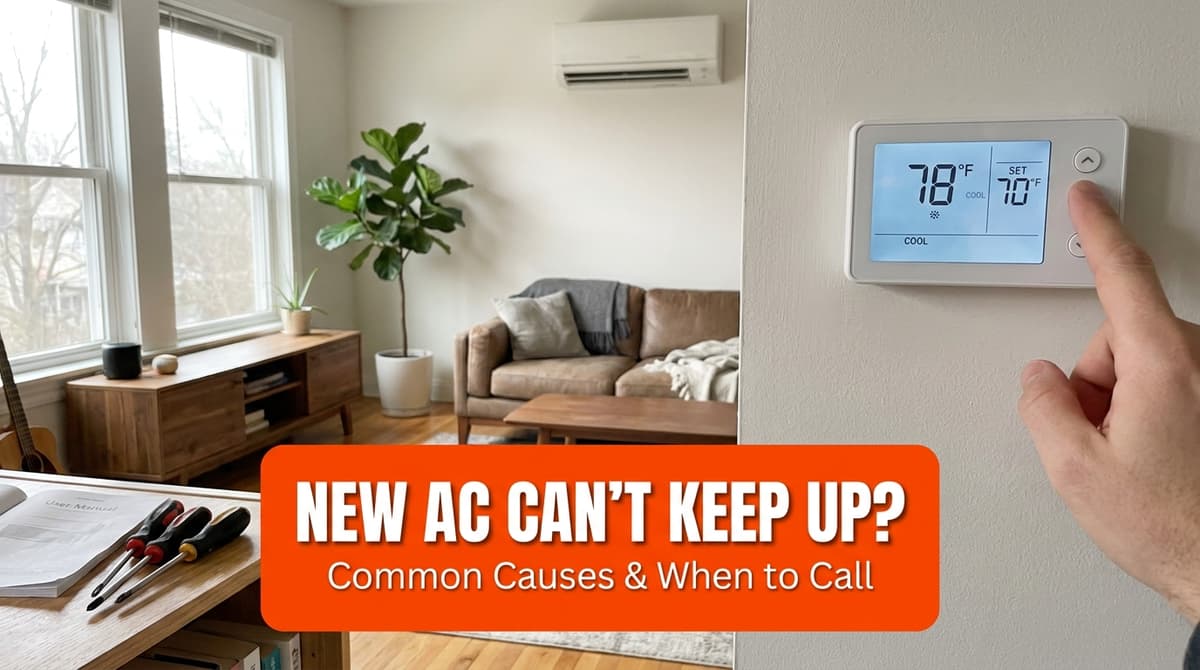
Why Your New AC Might Struggle in Real Summer Heat
We recently got a call from a homeowner — let’s call her Linda — who was more than a little frustrated. She told us, “Our air conditioner is relatively new, but it just won’t keep up. It runs nonstop during the day, we’ve got three small window units helping it out, and the house still isn’t comfortable.”
On top of that, the installer who put the system in during cooler weather had become impossible to reach. The unit was only about six months old, there was an addition under construction, and she was worried that having the AC run all day might damage it.
We hear some version of Linda’s story a lot, especially after the first real heat wave of the year. A “new” air conditioner that can’t keep up doesn’t necessarily mean it’s a bad unit — but it does mean something needs attention.
What’s “Normal” When It’s Really Hot Outside?
First, it helps to know what’s reasonable to expect from a modern central AC system.
- Design temperature difference: Most systems are designed to cool your home to about 20°F below the outdoor temperature. So if it’s 100°F outside, 78–80°F inside might be realistic, not 68°F.
- Long run times in heat waves: On very hot afternoons, it’s normal for your AC to run almost continuously. Long run time by itself isn’t always a problem if the system is holding temperature and the home feels reasonably comfortable.
- Short cycling is not normal: The opposite problem — turning on and off every few minutes — is harder on the equipment than long, steady cycles.
So when do we get concerned? When the system runs for hours, never reaches the thermostat set point, and the home still feels muggy or unevenly cooled. That’s where Linda was — and that’s when you should start looking for causes.
Common Reasons a New AC Can’t Keep Up
With Linda, there were a few red flags right away: a recently installed system, an ongoing addition, and the fact that she needed window units just to get through the day. Here are the most common issues we find in situations like hers.
1. The System Is Undersized (Especially After a Remodel)
If your system was sized for the original square footage and you’ve added rooms or opened up spaces, the original load calculation may no longer be accurate. Even without an addition, some installers “guess” on size instead of doing a proper Manual J calculation.
Signs this might be the problem:
- Unit runs nonstop during the day and rarely cycles off.
- Some rooms (often the new addition) never feel comfortable.
- The problem started or got much worse after a remodel or addition.
2. Low Refrigerant or a Refrigerant Leak
Linda suspected the system might be low on refrigerant because it was installed in cooler weather. That’s actually a good instinct — charge issues and small leaks often show up only once we hit real summer temperatures.
Possible clues:
- Weak, lukewarm air from the supply vents.
- Outdoor unit icing up or frost on the refrigerant lines.
- System used to cool well, but performance has slowly declined.
Refrigerant is not a “top-off every year” item. If a new system is low, there’s usually a leak or improper charge that needs to be corrected, not just refilled.
3. Airflow and Ductwork Problems
Even a perfectly sized, perfectly charged system can struggle if the air can’t move properly. Linda mentioned that part of her system was in the attic and she couldn’t see much of it — that’s common, and it’s exactly where issues like these hide:
- Crushed, undersized, or disconnected ducts (often in attics or crawlspaces).
- Closed or blocked supply registers and return grilles.
- Dirty filter or restrictive “allergen” filters the system wasn’t designed for.
Any of these can force the system to run longer, cool less, and still fail to keep up.
4. Construction Dust and a Rough Job Site
Linda’s home looked like a construction site because of a long-delayed addition. Renovations create dust, debris, and sometimes open wall cavities that let hot, humid air infiltrate the home. If filters aren’t changed more often during construction, coils and blowers can get dirty fast, hurting performance.
What You Can Check Before Calling an HVAC Tech
There are a few simple things you can safely check on your own. We often walk homeowners through these steps on the phone before scheduling a diagnostic:
- Filter: Make sure it’s clean, installed in the right direction, and not an overly restrictive type your system can’t handle.
- Vents and returns: Open all supply registers and returns; move furniture, rugs, and curtains away from them.
- Thermostat: Confirm it’s set to “Cool” and “Auto,” and that the temperature setting hasn’t been changed by accident.
- Doors and windows: During the hottest part of the day, keep exterior doors and windows closed and blinds or curtains drawn on sun-facing windows.
If everything above looks good and your relatively new AC still can’t keep up, it’s time for a professional diagnostic.
When to Call an HVAC Technician
With Linda, we scheduled a diagnostic visit instead of just a “free estimate.” That $59 visit got a certified technician to her home with the tools and materials needed to diagnose and often repair the problem on the spot.
You should call an HVAC tech if:
- The system is under a year or two old, but struggles in normal summer heat.
- You’ve added an addition or finished a basement since the system was installed.
- The AC runs nonstop and still can’t reach the thermostat set point.
- You suspect low refrigerant, hear unusual noises, or see ice on the unit.
On a typical visit, we’ll check refrigerant levels, measure temperature drop across the system, inspect ductwork and airflow, and verify that the unit is properly sized for the home as it sits today — not before the addition.
Worried Your New AC Isn’t Keeping Up?
If your story sounds a lot like Linda’s — a new system that runs all day, can’t keep up, or needs help from window units — something isn’t right, and it’s worth tracking down the cause before the next heat wave hits.
We’re always happy to come out, give you a clear diagnosis, and, when possible, fix the problem in the same visit so your AC can finally do the job it was installed to do.