New HVAC System Cost: Warranties & Payment Options
Wondering what a new HVAC system really costs? We break down typical prices, warranties, and payment options using a real homeowner’s situation as an example.
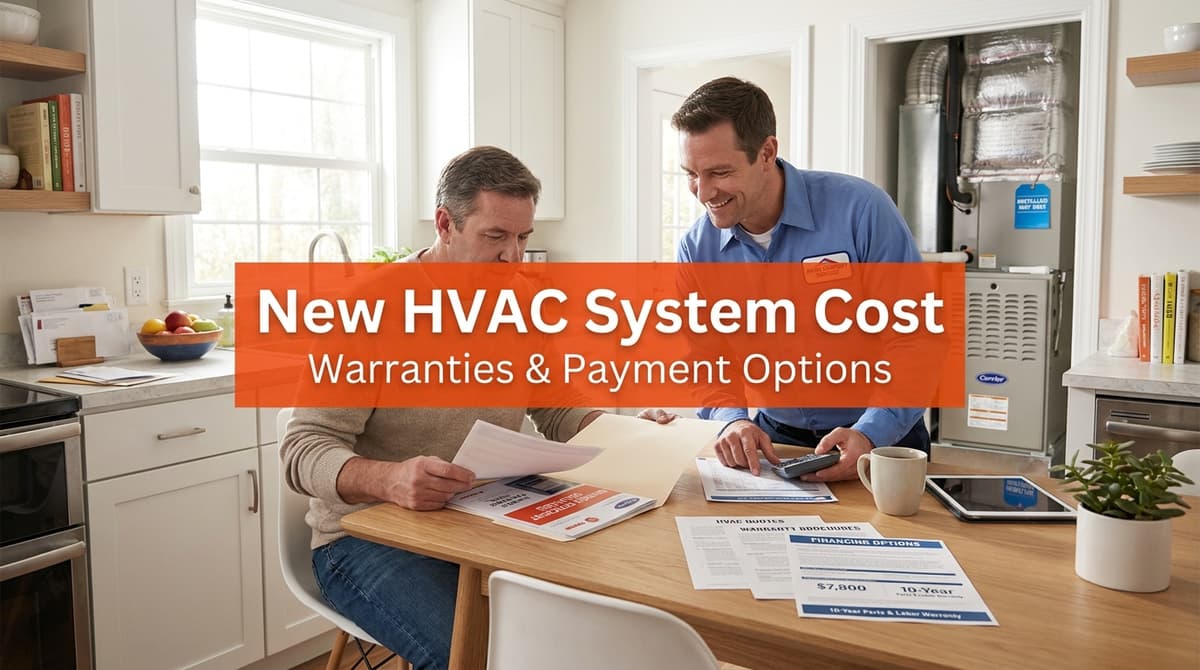
What a Real New HVAC Quote Conversation Sounds Like
We recently got a call from a customer — let’s call her Emily — who was stationed overseas on a military base. Her mom lives here in Arkansas in a one-story, three-bedroom brick home, and Emily wanted to surprise her with a brand-new heating and air system.
Her mom had already invested in all new ductwork under the house, but the outdoor unit and indoor equipment were worn out and giving her trouble. Emily’s biggest question was simple and very familiar to us:
“How much does a new HVAC system cost, and how do payments and warranties work?”
If you’re asking the same thing, you’re not alone. Let us walk you through exactly what we told her, so you know what to expect for your own home.
Typical Cost Range for a New HVAC System
On the call with Emily, we talked through some ballpark numbers. With her mom’s three-bedroom, single-level brick home and existing ductwork in good shape, we could give a pretty realistic range.
For most standard residential installs we see, complete system replacements typically run:
- Around $8,500–$9,000 on the low end (smaller systems, certain efficiency levels)
- Commonly $9,000–$13,000 for the majority of homes
Emily had guessed about $10,000 as a “throw it at the wall” number — and we told her that was actually a pretty realistic middle-of-the-road estimate for many homes like her mom’s.
What Affects the Final Price?
The reason we always recommend an in-person estimate is that several key details affect cost:
- System size (tonnage): How much heating and cooling your home actually needs.
- Efficiency rating (SEER2, etc.): Higher efficiency often costs more up front but can lower utility bills.
- Ductwork condition: In Emily’s case, new ductwork was already in place, which helps keep costs in that average range.
- Home layout & construction: Single-story vs. two-story, brick vs. other exteriors, insulation levels, and so on.
That’s why we send our HVAC manager or comfort specialist out to the property: to size the system correctly, check the existing equipment and ductwork, and then give a written estimate — not just a guess.
What Kind of Warranty Should You Expect?
One of Emily’s biggest concerns was taking care of her mom long-term, so she asked us directly about warranties on both equipment and labor.
Here’s what we explained:
- 10-year parts warranty on new installs (manufacturer-backed, when registered properly)
- 3-year labor warranty from us on new installs
In many places, a 1-year labor warranty is the standard. We choose to offer up to 3 years of labor coverage on new systems because we want our customers to feel confident that if something wasn’t done right, we’ll be back to make it right — at no additional labor cost during that period.
Emily’s follow-up question was important: “Is that extra, or is it included?” We told her what we tell everyone — those warranties are included in the quoted price for a new system, not tacked on later as a surprise upgrade.
Cash, Checks, Bank Transfers & Financing: How Payment Works
Because Emily was calling from overseas, she needed to know exactly how she could pay for the system and whether paying up front would help.
Yes, There’s a Cash-Type Discount
We explained that we offer a cash discount of up to about 6%, depending on the system. That discount usually applies when you’re not using traditional financing — instead you’re paying by:
- Personal check
- Cashier’s check
- Bank transfer / ACH from your bank
Emily asked if her debit card would count like cash. We told her we’d need to verify the details with our payment processor, but the main idea is: no credit card and no third-party financing if you want the full “cash” discount. A cashier’s check or direct bank transfer is usually treated the same as cash.
Financing Options for Spreading Out the Cost
Of course, not everyone has $9,000–$13,000 sitting in savings. That’s why we also offer financing options through partner programs.
With financing, the system price may be structured differently than with a cash discount, but the tradeoff is you can spread payments out over time instead of paying the full amount up front. During the estimate visit, we can walk through:
- Available term lengths
- Estimated monthly payments
- Any promotional rates, if offered at that time
For someone like Emily, who wanted to help her mom but also had to watch her own budget, it was reassuring to know that both options — lump-sum payment with a discount, or monthly payments with financing — were on the table.
Why an In-Home Estimate Still Matters
Even though we could give Emily a solid ballpark over the phone, we encouraged her to let us come out and look at her mom’s system before making any final decisions.
During an in-home estimate, we:
- Confirm the correct size (tonnage) of the system
- Check the condition and design of the ductwork
- Discuss efficiency options and budget
- Review warranty coverage and payment choices in writing
That way, there are no surprises — just a clear plan, a firm price, and a path that fits your budget and comfort needs.
Thinking About Replacing Your HVAC System?
If you’re in a situation like Emily — whether you’re replacing a worn-out unit or trying to help a family member from out of town — we’re here to make the process straightforward.
We’ll walk you through realistic pricing, warranty coverage, and payment options, then back it all up with a professional in-home estimate so you can make a confident decision on your timeline.