Should You Move Your Electrical Panel? Cost, Safety & Design
Thinking about moving an electrical panel for a finished basement or Airbnb? We break down costs, safety, and smarter alternatives from an electrician’s viewpoint.
“Is the Juice Worth the Squeeze?” A Real Call About Moving a Panel
We recently got a call from a homeowner — let’s call her Emily — who was finishing out a basement space to use as a mix of in-law suite and short-term rental. The electrical panel was on an interior wall of that new living area, and the meter was on the exterior wall right behind it.
Emily’s big question: “Should we move the electrical panel outside, or just leave it and hide it somehow? Is the juice worth the squeeze?” She also noticed her exterior meter was labeled 200 amps while the interior panel was 150 amps and wasn’t sure what that meant.
We walk through this decision with homeowners all the time, especially for finished basements, in-law suites, and Airbnb spaces. Here’s how we helped Emily think it through — and how you can, too.
When Does It Make Sense to Move an Electrical Panel?
In Emily’s case, the panel backed up to an exterior wall with the meter outside. That’s actually the best-case scenario if you’re going to relocate, because we can often move the panel to the outside without junction-boxing every circuit all over the place.
But even in that ideal situation, relocating a panel is not a small project. By the time we:
- Install a new exterior panel and weatherproof it
- Re-route service conductors
- Land all the existing circuits and add any new ones
- Bring grounding and bonding up to current code
…you’re usually talking about several thousand dollars. That’s the “juice vs. squeeze” part: is the benefit worth that spend?
Pros of Moving the Panel to an Exterior Wall
- Fresh equipment: You typically get a new panel, new breakers, and often a service upgrade at the same time.
- Longevity and safety: Old or crowded panels, double-tapped breakers, and outdated grounding often get corrected in the process.
- Cleaner interior design: No big gray box in your finished space or guest suite.
- Easier utility access: Power company and emergency responders can get to the main disconnect quickly.
Cons of Moving the Panel Outside
- Cost: Even in a “simple” case like Emily’s, it’s still a multi-thousand-dollar project.
- Construction impact: Some drywall/finishes will be disturbed, inside or out.
- Not always necessary: If the existing panel is in good shape and not overloaded, you may not gain much besides looks.
Our honest rule of thumb: if your main goal is purely aesthetic or to keep curious hands away, relocating often isn’t worth the cost. If your goal is upgrading old or undersized equipment anyway, then moving outside can be a smart part of a bigger project.
What If the Meter Says 200A and the Panel Says 150A?
Emily’s other concern was that her meter base outside was labeled 200 amps, but the interior panel was 150 amps. We see this mismatch a lot, and it confuses homeowners.
In simple terms:
- The meter rating tells you what the utility-side gear can handle.
- The panel rating tells you what your interior distribution panel can safely handle.
So a 200A meter with a 150A interior panel usually means the home is effectively a 150 amp service, limited by the panel. That’s not automatically a problem. Many homes run perfectly well on 100–150 amps, even with a finished basement, if the loads are designed correctly.
We start talking about a full upgrade to 200A when:
- You’re adding large electric appliances (EV charger, electric range, heat pump, hot tub, etc.).
- Breakers are constantly tripping, or there’s no room for new circuits.
- The existing panel is old, rusted, damaged, or a known problematic brand.
In those cases, upgrading the service and panel — and potentially moving it outside while we’re at it — can absolutely be worth the investment.
Cheaper Alternatives: Hiding a Panel the Right Way
In Emily’s situation, they planned to live on the side of the house where the panel was, and rent out the other part. That made the panel’s location less of a deal-breaker. We told her what we tell a lot of homeowners:
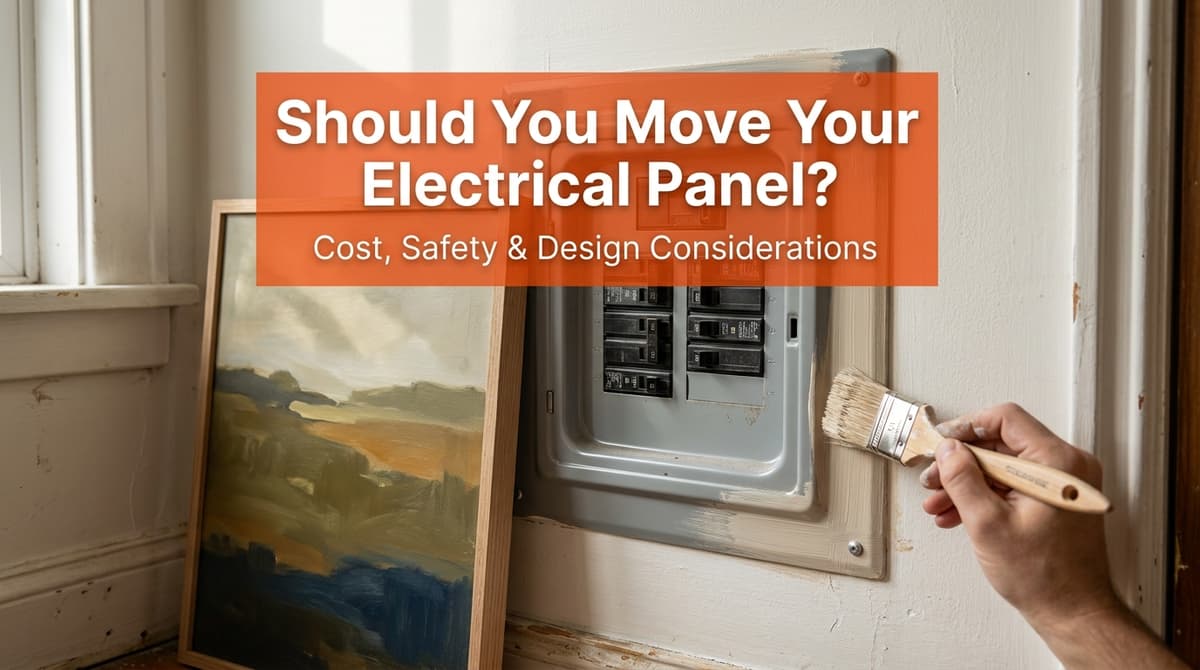
- Paint the cover to match the wall so it blends in.
- Hang artwork or a decorative panel over it, using hinges or an easy-to-remove mount.
The key is staying code-compliant:
- Maintain at least 30" wide x 36" deep of clear working space in front of the panel.
- Don’t build a tight cabinet around it that makes access difficult.
- Make sure the cover can be opened quickly without tools.
Nine times out of ten, a simple paint-and-picture solution satisfies both design and safety, without spending thousands on relocation.
Panels in In-Law Suites and Airbnb / Short-Term Rentals
Basement in-law suites and Airbnb spaces raise a few unique questions we walked through with Emily, and we walk through with other homeowners, too.
Should Guests Be Able to Reach the Panel?
From an electrician’s point of view, we actually want someone on-site to be able to shut power off in an emergency. Locking the panel away where only you can reach it isn’t ideal if a breaker trips or there’s a burning smell and guests need to cut power fast.
That said, we also understand you don’t want guests flipping your main off just to see what happens. A few practical recommendations:
- Keep the panel accessible but visually hidden (artwork, decorative door, etc.).
- Label breakers clearly so guests can reset a tripped circuit without guessing.
- Include a small “what to do if a breaker trips” note in your house manual.
When a Separate Panel or Upgrade Makes Sense
If you’re doing a true in-law suite or high-usage short-term rental with its own kitchen, laundry, and HVAC, we may recommend:
- Adding a subpanel dedicated to that suite, or
- Upgrading the main service and panel to add capacity safely.
This keeps circuits organized, helps with troubleshooting, and can be a selling point if you ever convert the space to a long-term rental.
So… Is the Juice Worth the Squeeze for Your Panel?
Here’s how we summed it up for Emily, and how we’d encourage you to think about it:
- If your panel is old, crowded, or undersized and you’re already planning upgrades, relocating outside and installing new gear can be a smart long-term move.
- If your main concern is aesthetics or guest curiosity, consider paint, artwork, or a discreet door first. Most of the time, that solves the problem for a fraction of the cost.
- If you’re adding an in-law suite or Airbnb, talk with a licensed electrician about load calculations, subpanels, and access so you’re safe, code-compliant, and guest-friendly.
As a team, we’re not interested in selling a big project you don’t really need. Our goal is to lay out the options, the costs, and the trade-offs so you can decide if, for your home and budget, the juice really is worth the squeeze.